Synthetic Score Benchmark Tests

These were pretty easy to do. The first is an known AI generated author picture and fake profile from the Sports Illustrated AI scandal (90 Synthetic Indicators), and the second is a fake article I had Claude make for me (60 Synthetic Indicators). Note that 60 is probably the most realistic signal one can get from prose as LLMs are getting so good at making it seem like a human wrote it.
Sanity Media 2.4 Score (GPT 5.6 Sol):
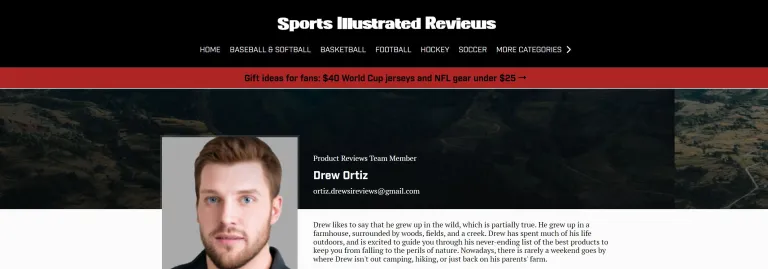
Sports Illustrated “Drew Ortiz” example
Mainstream Alignment: 20
Accuracy: 20
Clickbait: 40
Toxicity: 10
Synthetic Indicators: 90
Summary:
Mainstream Alignment is low because the presented reviewer identity was not supported by the later public record. Accuracy is low because the apparent identity and biography were not independently corroborated and were substantially undermined by reporting around the synthetic portrait and pseudonymous persona. Clickbait is moderate because the bio uses light personality and promotional framing without strong engagement engineering. Toxicity is minimal. Synthetic Indicators are very high because the portrait itself was traced to an AI-generated-headshot source, with additional templated persona characteristics.
Signal pattern:
20 / 20 / 40 / 10 / 90
Institutional Omission:
Not triggered.
Wexham County bridge article (posted below - Claude Opus 5 generated this one)
Mainstream Alignment: 90
Accuracy: 10
Clickbait: 40
Toxicity: 10
Synthetic Indicators: 60
Summary:
Mainstream Alignment is very high because the piece closely resembles conventional local-government reporting in structure, sourcing, tone, and subject matter. Accuracy is very low because the central setting and government entities fail verification, including the apparent nonexistence of Wexham County, Ohio. Clickbait is moderate and consistent with ordinary modern local news. Toxicity is minimal. Synthetic Indicators are elevated because of the highly regular structure, balanced quotation pattern, clean transitions, and unusually tidy completeness, but those traits overlap with competent human reporting.
Signal pattern:
90 / 10 / 40 / 10 / 60
Institutional Omission:
Not triggered.
Wexham County delays Route 9 bridge replacement after bids come in $6 million over estimate
AI-Generated article:
WEXHAM, Ohio — Wexham County commissioners voted 2–1 Tuesday to postpone replacement of the Mill Creek bridge on State Route 9 after all three construction bids exceeded the county's engineering estimate by at least 30 percent.
The lowest bid, $24.7 million from a Columbus-based contractor, came in roughly $6.3 million above the $18.4 million the county engineer's office projected last fall. The other two bids were $25.9 million and $27.2 million.
"I'm not signing a contract that's a third over what our own engineers told us it would cost," said Commissioner Dana Pruitt, who made the motion to reject the bids. "If the number is wrong, we need to understand why before we commit taxpayers to it."
The two-lane steel girder bridge, built in 1961, was rated in poor condition during a 2023 state inspection. The county lowered its load limit to 15 tons last spring, forcing loaded grain trucks and gravel haulers onto a detour that adds about 11 miles each way.
Commissioner Ray Okafor, who cast the dissenting vote, said delaying the project will likely cost more in the long run.
"Rebidding means we lose another construction season, and I haven't seen prices come down in four years," Okafor said. "Meanwhile, that bridge isn't getting any younger."
County Engineer Lisa Tran told commissioners the gap reflected higher-than-expected costs for structural steel and precast concrete, along with a shortage of qualified crews. Two of the three bidders listed subcontractor availability as a risk factor in their proposals, she said.
Tran said her office will look at reducing the project's scope, including dropping a planned 8-foot pedestrian path or splitting the work into two phases. A revised package could go back out for bids as early as January.
For businesses along the detour route, the delay is another year of added fuel and driver costs.
"We run about 40 loads a week during harvest," said Mark Delacroix, manager of Wexham Grain & Feed. "Every one of those is an extra 20-some miles now. It adds up fast."
The county had planned to cover about 80 percent of the project with state and federal bridge funds, with the remainder coming from its permissive license fee revenue. Tran said the funding commitments remain in place but could be affected if the project is not under contract by the end of the 2027 fiscal year.
Commissioners are expected to review the revised design options at their Nov. 10 meeting.


